I am getting an increasing number of customers asking me about Starlink and whether I would recommend it for their practice. So here is my honest answer, which starts with an admission: I have not yet seen it live and reliable in a single UK dental practice, and it is hard to vouch for something we have not seen or used in anger.
That is not a dig at the technology. I have just come back from holiday in Canada, and the Virgin Atlantic flight had Starlink on board. I FaceTimed my daughter without issue at 40,000 feet, which frankly is remarkable, so I am quite sure it works. But "it works on a plane" and "I would bet a dental practice's working day on it" are different claims, and without specific dental experience, any firm recommendation from me would be misplaced. What I can do is walk you through the practical realities, because they are not what most people expect.
First practicality: you cannot just point it at a window
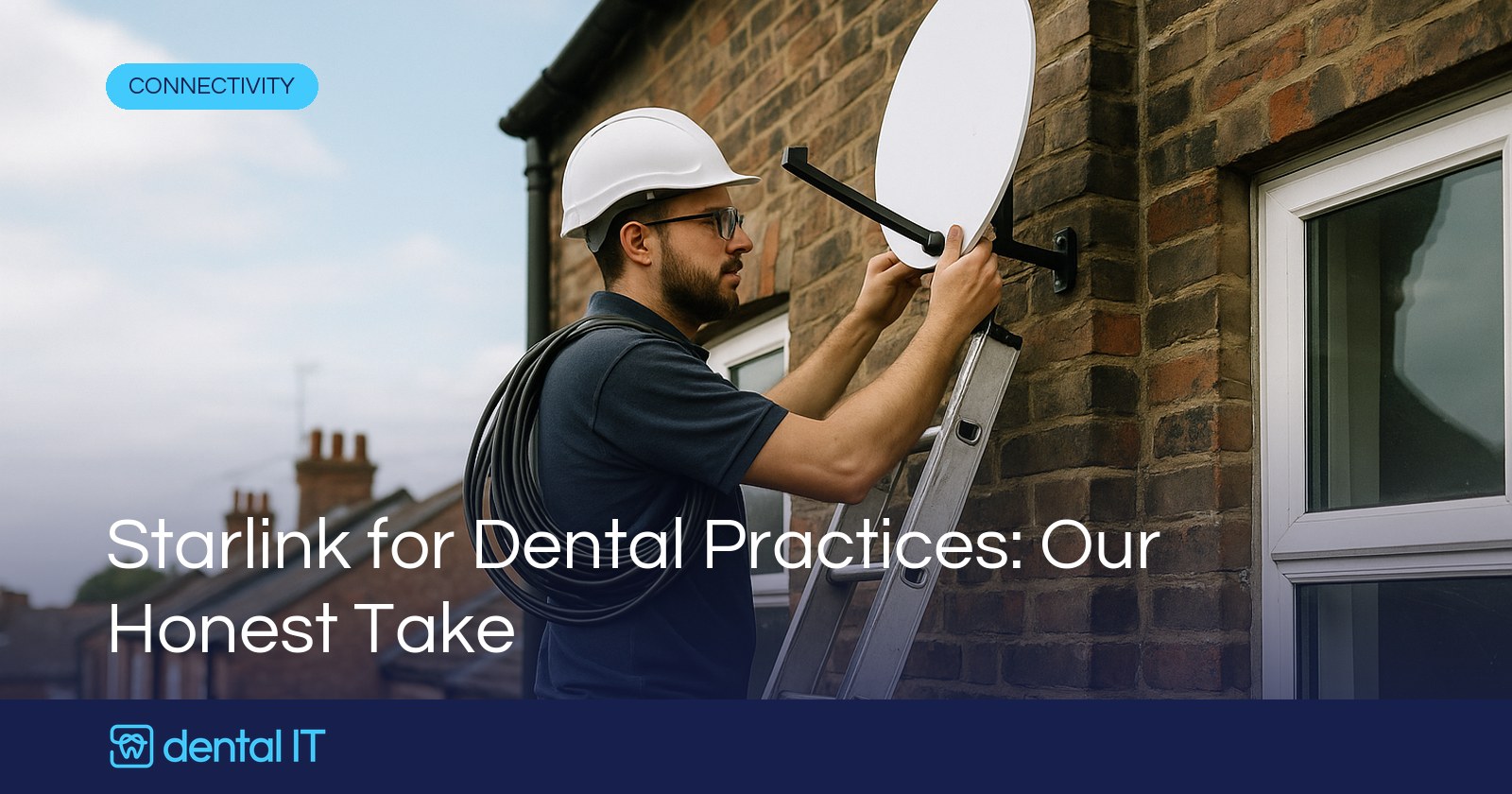
The dish needs a clear view of the sky. You can sit it inside pointing through a window, and it may even work, but there are no guarantees it will be reliable that way. Done properly, it is supposed to be mounted externally, on a wall bracket or the roof, with cabling run back inside.
For a house that is a Saturday job. For many practice buildings, a listed frontage, a rented premises, a first-floor surgery in a terrace, it is not a trivial proposition at all. Before you think about the service, think about whether you can actually mount the thing.
Second: the speeds are not what fibre gives you
Starlink is impressive for satellite, but it is not in the same league as a proper fixed line. Typical Starlink bandwidth is around 200 Mbps. Full fibre (FTTP, fibre to the premises) delivers 1,000 Mbps and increasingly 10,000 Mbps.
Latency is the other half of the story, and the half people forget. Latency is the time traffic takes to go back and forth, and it is what makes cloud systems, video calls and phones feel snappy or sluggish. It is fastest over fibre optic, and Starlink's is up to four times higher, because your traffic is literally going to space and back.
So the ranking has not changed: fibre optic and leased line technologies are still the king in this space. Starlink does not dethrone them, it sits below them.
Third: the cost is more than people assume
Let us leave the residential plans aside, because you are a business and should be on the business service. At the time of writing, the business plans run from around £30 a month up to roughly £296 a month for up to 2TB of priority traffic.
That 2TB figure matters, because it is not unusual for our typical medium to larger sites to use 1 to 2TB of data a month quite easily. Which means that for a busy practice, Starlink can end up costing as much as a leased line, without the speed, and crucially without the guarantees. A leased line comes with a real SLA and an obligation to fix. Starlink comes with neither.
Fourth: the fixed IP question
This one is niche but important. Plenty of practice infrastructure works best, or only works safely, with a fixed public IP address: some IP phone setups, VPNs and remote access, site-to-site links between practices, and whitelisting your practice's address with cloud systems such as Dentally so access is locked to your premises.
Starlink's business service appears to offer a fixed IP, but the specifics suggest it can change and is not necessarily yours or permanent. That makes it potentially unsuitable for exactly the setups above. If your practice relies on any of them, this alone could rule Starlink out as a primary line, and it ties into why your internet, phones and IT need designing as one system.
So where does Starlink actually fit?
Here is my honest position. Starlink is an interesting proposition and I genuinely look forward to a practice running it in anger so we can all learn from it. But on today's evidence, I would place it in two roles rather than as a main line:
- Backup and failover. As a second connection that takes over when the main line fails, satellite has real appeal, because it shares no infrastructure with your fibre. A digger through the street cabinet cannot take both out.
- The hard-to-reach site. For a very rural practice that is struggling to get a decent fixed line at all, Starlink may honestly be the best available option, and a far better one than limping along on poor copper.
For everyone else, the boring advice stands: a proper fibre line, sized to how your practice actually works, with guarantees behind it, and mobile or satellite as the safety net rather than the star of the show.
If you are weighing up Starlink, or wondering whether your current connection is really the right one for how much now runs through it, get in touch and we will give you a straight, vendor-neutral view. And if you are a UK practice already running Starlink day to day, I would genuinely love to hear how it is going. You would be teaching us something.