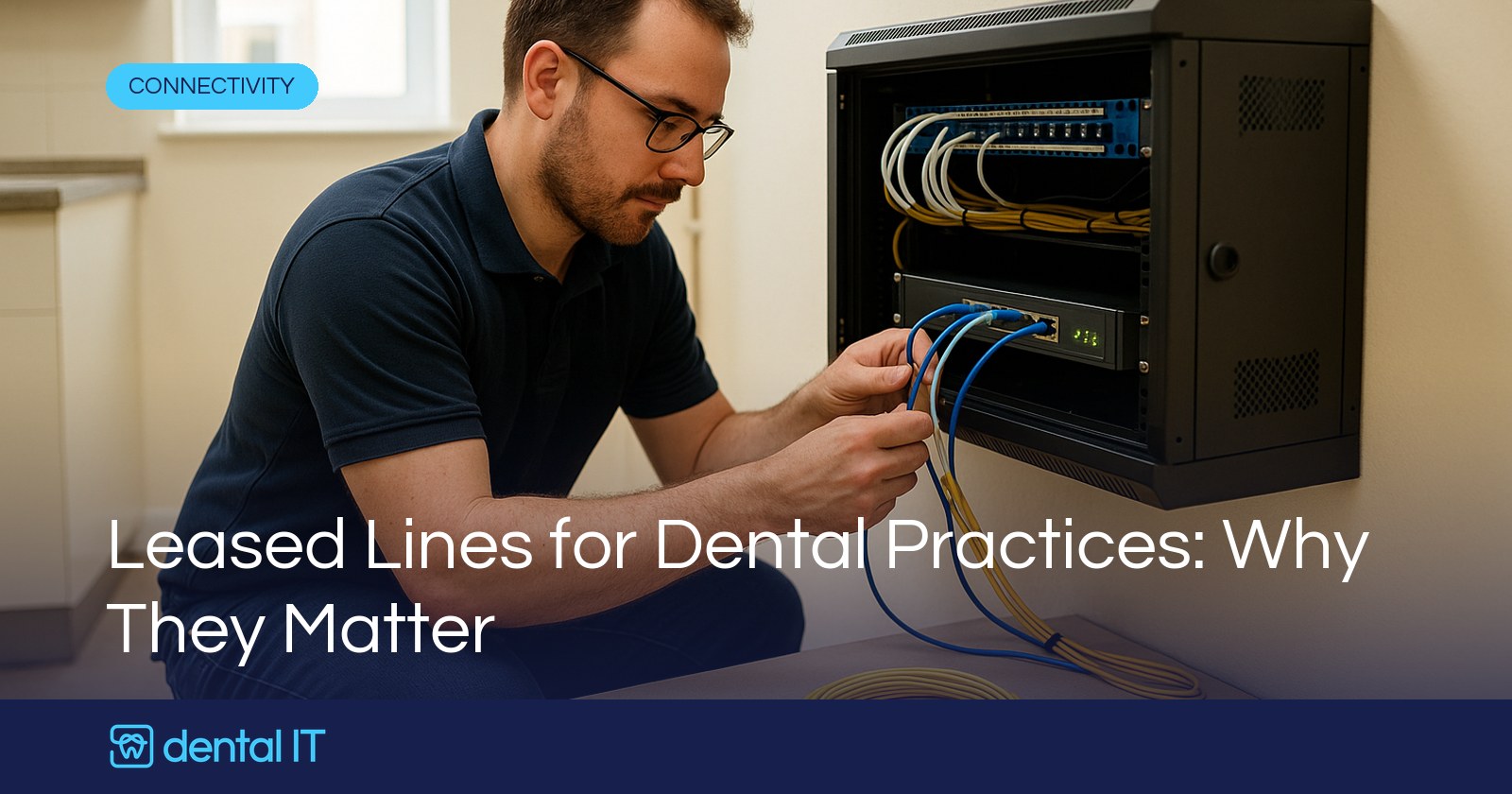
If your practice went offline right now, how long could you keep working, and how quickly would anyone be obliged to fix it? For most practices the honest answer is "not long" and "no idea", and that is worth thinking about before it happens rather than during. This is where leased lines come in, and why they are the gold standard for any business that genuinely cannot afford to go dark.
Most people assume their internet is their internet, and that a line is a line. It is not. What you are really buying with a cheap connection is best effort, and best effort is exactly what it sounds like.
What you are actually getting on a standard line
A typical FTTC (part fibre, part copper) or even full-fibre FTTP broadband line is a consumer-grade or near consumer-grade product. It usually works fine, right up until it does not. The part most practices never check is what happens then.
On a standard line, the service level agreement, if there is one at all, is often a 48 hour target just to respond, and that is the response, not the fix. The time to actually repair the fault is frequently not even a stated aim. It could be days. In a bad case, with a street cabinet or a cable fault, it can be weeks. There is usually no meaningful compensation, no real escalation path, and no leverage, because none of that is part of what you bought. And to be fair to the providers, what do you expect for around fifty pounds a month?
Here is the rule of thumb. If you are paying less than about a hundred pounds a month for your connection, it almost certainly has no proper SLA, no guarantees worth the name, and a slow, vague response when something breaks. That is the day you find yourself walking round the practice plugging important PCs into your phone's hotspot, hoping it holds.
Why this matters more than it used to
A few years ago, an internet outage was an inconvenience. You could still see patients, the practice management system was on a server in the back room, and the phones were on a separate line.
The move to cloud has quietly changed all of that. Your practice management software, your imaging, your email, your card payments, increasingly your phones, all now lean on that one connection. We think it is a genuinely good move, and we have written before about running a modern practice without an ageing server in the cupboard. But it raises the stakes on the line itself. When everything runs through one pipe, that pipe stops being a convenience and becomes critical infrastructure. If it goes, the practice can be completely unable to operate, not just a bit slower.
The 4G and 5G question
At this point someone always says they are covered, because they can get a 4G router from one of the big providers and carry on. It is a fair thought, but do not assume it will work when you actually need it.
Mobile signal indoors is often poor, especially in a solid building with people and equipment between you and the mast. A signal that is fine for answering a few emails on your phone by the window is a very different thing from enough indoor bandwidth to run a whole practice. Done properly, mobile failover can be excellent, with a correctly specced 5G router and usually an external aerial to pull in a clean signal. But that is a designed failover project with its own scope, not a cheap box from a high street shop that you hope does the job. Treated as an afterthought, it tends to disappoint at the worst moment.
The gold standard: a leased line
The proper answer, for a business that cannot go down, is a leased line. It is a dedicated connection that is yours alone, not shared with the street, and crucially it comes wrapped in a contract that actually means something.
Leased lines typically start from around a hundred and fifty pounds a month and run up to three hundred and fifty or more, depending on speed and location. For that you get the things the cheap line never had:
- A genuine SLA with a target fix time, often around six hours, not just a response.
- Cover 24 hours a day, 7 days a week, 365 days a year.
- Properly staffed helpdesks and engineers who are obliged to act.
- Business-grade equipment built to last, the likes of Cisco or Juniper, rather than the plastic router that came in the post.
Want proof this is normal for serious operations? Walk into your local Co-op, or your GP practice, and there is almost certainly a leased line behind the scenes. Why? Because they cannot go down. For them an outage is commercially damaging, reputationally damaging, or in the case of healthcare potentially dangerous. A dental practice sits in exactly the same category, even if it has never framed it that way.
Getting real about your connection
The uncomfortable truth is that a lot of practices are still running on a thirty or forty pound connection that someone would order for their house, and quietly betting the whole business on it. That bet is fine until the day it is not.
Getting real means matching the connection to what now depends on it. For many practices that means a leased line as the primary, often with a properly designed 5G failover behind it, so a single fault never stops the day. It costs more than consumer broadband, because it is a genuinely different product with people and guarantees behind it.
If you are not sure what you are currently on, what its SLA actually says, or whether a leased line is the right call for your practice, that is exactly the kind of thing we work out with practices every week. It is worth understanding how your connection ties into your phones and the rest of your IT before something forces the issue. Get in touch and we will give you a straight assessment, no jargon.